

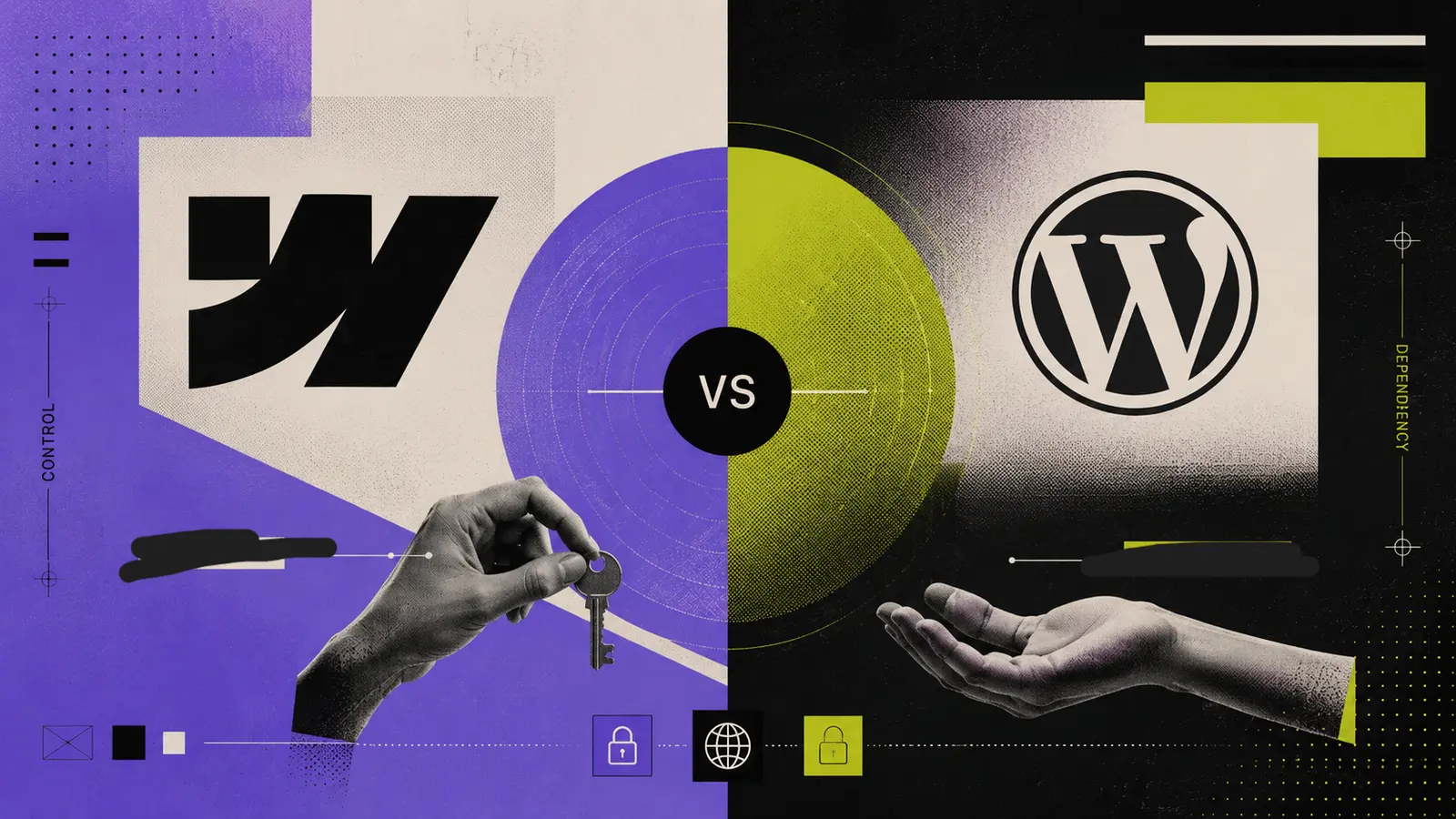
For most businesses that want a marketing site they can update themselves without calling a developer, Webflow is the better choice in 2026. WordPress earns its place when you genuinely need its plugin ecosystem or complex publishing workflows, and it charges rent for that power in maintenance someone has to own. That's the verdict. Here's the reasoning, including where we'd tell you not to listen to us.
What you're actually comparing
WordPress is open-source software you host and maintain: themes for the look, plugins for features, a database underneath. Infinite flexibility, and a stack of moving parts that need patching, updating, and un-breaking for the life of the site. Webflow is a hosted platform: design, CMS and hosting in one, nothing to patch, and a visual editor your marketing team can use without breaking the layout. Less can go wrong because less is yours to run.
Where Webflow wins
The ownership question, mostly. On Webflow, the person who updates your site is you: edit the page, publish, done, with no plugin conflicts waiting and no maintenance retainer running in the background. Sites tend to be faster out of the box because there's no plugin weight to accumulate, and the design ceiling is high without touching code. For a services business, a manufacturer, a firm: a site whose job is to present the business well and convert enquiries, that covers everything the site needs to do.
Where WordPress wins
Genuine edge cases, and they're real. A publishing operation with complex editorial workflows, dozens of authors, and content tooling built over years. A site whose business logic lives in specific plugins with no platform equivalent. Membership and community setups with deep WordPress integrations. Total code ownership as a requirement rather than a preference. If that's you, WordPress isn't legacy, it's the right tool, and migrating away would cost more than it returns. Just budget for the truth that comes with it: a WordPress site is a small system you operate, not a page you publish.
The maintenance line nobody puts in the quote
WordPress quotes routinely come in lower than Webflow builds, and the gap is frequently an illusion: the WordPress number rarely includes the care plan, the plugin licences, the update testing, and the developer hours when an update breaks something. Priced over three years with honest maintenance included, the totals converge, and the Webflow site spent those three years being updated by your team instead of a vendor's.
Where we stand
We build on Sanity, Webflow, and Shopify, chosen per project by requirements, and we don't build on WordPress at all. If your requirements point there, we'll say so on the first call and point you to someone good rather than talk you onto our stack. Our website builds run $10,000 to $50,000 and ship in weeks; the full cost breakdown is here, and if you're weighing Webflow against a fully custom build instead, we've compared those separately.
FAQ
Is Webflow better than WordPress for SEO?
Neither platform ranks you; content and authority do. Webflow gives you clean technical foundations by default, while WordPress can match them with the right setup and discipline. The difference is that on WordPress, someone has to maintain that discipline.
Should I migrate from WordPress to Webflow?
Only if the maintenance load or editing friction is costing you something real. A working WordPress site with owned upkeep isn't a problem to fix. A site nobody on your team can update, with a care plan you pay reluctantly, usually is.
What does a Webflow website cost in Australia?
Professionally designed and built, typically $10,000 to $50,000 depending on scope, shipping in weeks rather than months. Ongoing platform costs replace the maintenance retainer a WordPress site of the same standard needs.